State of AI 2026
State of AI 2026 examines the point at which artificial intelligence stops being primarily a technology story and becomes an organizational and economic one. The paper looks beyond model capability to the harder questions now facing companies: where AI is creating real value, where investment is outrunning returns, how agents and AI-native businesses are reshaping markets, and why successful AI transformation will depend as much on operating models, culture, and human judgment as on the technology itself.
In this article
- EXECUTIVE SUMMARY
- 2026 AT A GLANCE
- 01 / THE ADOPTION ARC
- 02 / FROM FRONTIER MODELS TO INFERENCE ECONOMICS
- 03 / THE RISE OF AGENTS
- 04 / SOFTWARE DEVELOPMENT IS THE FIRST AGENTIC KILLER USE CASE
- 05 / AI-NATIVE COMPANIES AND THE APPLICATION LAYER
- 06 / WHO IS LIKELY TO GROW NEXT
- 07 / THE AI DATA-CENTER BUILDOUT
- 08 / WHERE AI SITS ON THE HYPE / ADOPTION CURVE
- 09 / ENTERPRISE ROI: THE VALUE GAP IS ORGANIZATIONAL
- 10 / AI TRANSFORMATION IS ORGANIZATIONAL REDESIGN
- The three maps: Process. Culture. Cognition.
- 11 / WORK, TALENT AND THE CHANGING VALUE OF EXPERTISE
- 12 / AI AND HUMAN COGNITIVE ABILITY
- 13 / 12-24 MONTH OUTLOOK: AUGUST 2026 TO AUGUST 2028
- 14 / THE EXECUTIVE AGENDA
- METHODOLOGY AND INTERPRETATION
EXECUTIVE SUMMARY
The defining feature of AI in 2026 is no longer surprise that the technology works. It is the unevenness of what works, where it works, and who captures the value. Consumer adoption is massive. Model capability is still advancing. Coding has become the first large, clearly monetized agentic workload. Yet broad enterprise agents remain early, organization-level profit impact is inconsistent, and the infrastructure buildout is committing capital far faster than most final-use economics have been fully proven.
THE CORE SHIFT: The competitive question is moving from "Who has the smartest model?" toward "Who can effectively turn artificial intelligence into a reliable, low-cost, governable business outcome?"
Six conclusions for leaders
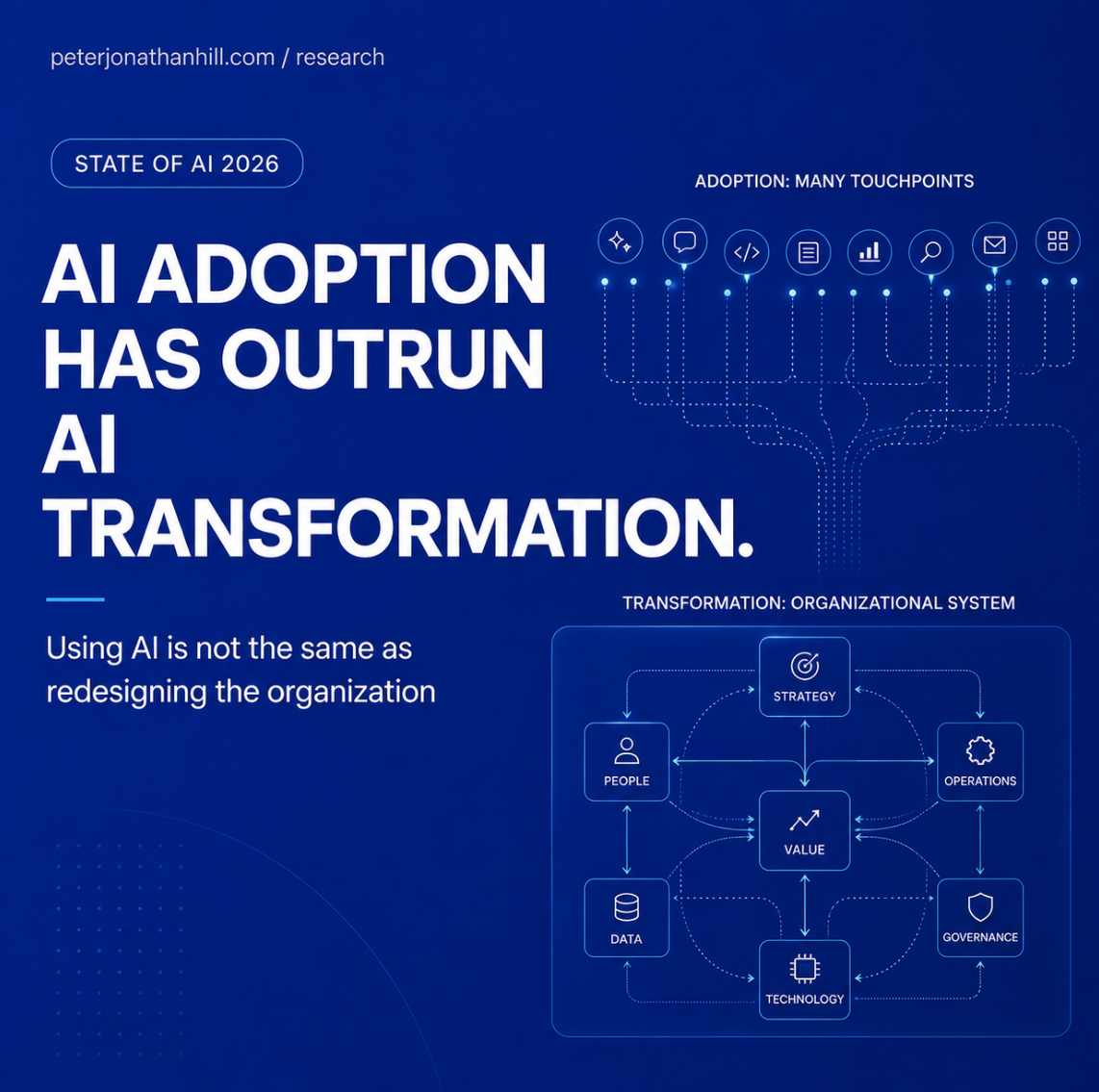
1. Adoption has outrun transformation. Stanford reports 88% organizational AI adoption, but McKinsey finds nearly two-thirds of organizations have not begun scaling AI enterprise-wide. The gap is not access to models; it is operating-model readiness.
2. Agents are real, but autonomy is still over-marketed. Agent benchmark performance improved dramatically in 2025, but Stanford still finds failure on roughly one in three structured attempts. Gartner places agentic AI at the Peak of Inflated Expectations.
3. Software development is the leading proof point. Menlo estimates $4B of enterprise generative-AI spend went to coding in 2025. Claude Code and Cursor each reached multi-billion-dollar run-rate revenue, while DORA finds AI is now embedded in the daily workflow of most technology professionals.
4. Inference economics now matter as much as frontier research. The cost of GPT-3.5-level inference fell more than 280-fold by late 2024, while 2026 model releases emphasize performance per dollar, routing, caching and efficient agent harnesses. The useful unit of economics is becoming cost per verified outcome, not cost per token.
5. The data-center boom is economically plausible but not uniformly justified. Demand is real and power requirements are growing quickly, yet more than $500B of 2026 AI investment implies years of future utilization and monetization. Hyperscalers with distribution and diversified cloud economics are better positioned than leveraged, single-purpose capacity.
6. AI transformation is organizational and cognitive, not only technical. The firms that benefit most will redesign processes, culture, decision rights, incentives, talent development and the human role in oversight. AI can amplify expertise, but poorly designed delegation can also erode the very skills needed to supervise it.
2026 AT A GLANCE
The market has crossed from experimentation into economic competition.
900M+ ChatGPT weekly active users reported in March 2026 | 88% Organizations reporting AI use in Stanford's 2026 Index | $37B Estimated enterprise generative-AI spend in 2025
$4B Estimated 2025 enterprise coding-AI spend | 17.1M H100-equivalent global AI compute capacity | 280× Drop in GPT-3.5-equivalent inference cost by Oct. 2024
17% Organizations Gartner says had deployed AI agents in 2026 | 39% McKinsey respondents reporting enterprise-level EBIT impact | 945 TWh IEA 2030 base-case data-center electricity demand
Interpretation: These metrics describe different layers and populations; they should not be collapsed into a single "AI adoption rate." The important pattern is their divergence: widespread access and spend coexist with immature agent deployment and incomplete profit realization.
The 2026 AI stack
Frontier models - Capability still improving, but leaders are converging on many benchmarks. Economic question: Can performance gains justify premium inference cost?
Inference / serving - Rapid optimization: smaller models, caching, routing, hardware efficiency. Economic question: How much verified work is produced per dollar of compute?
Agents - Strong momentum; narrow production use, weak long-horizon reliability. Economic question: Where does autonomy outperform deterministic automation or assistance?
Applications - Fastest monetization in coding; vertical and workflow-native categories expanding. Economic question: Who owns distribution, workflow context, evaluation and outcome data?
Enterprise operating model - Tool adoption ahead of process, culture and role redesign. Economic question: Can local productivity become enterprise P&L impact?
Human capability - Higher leverage for experts; skill-formation risks for novices and delegated work. Economic question: Which cognition should be offloaded, preserved or strengthened?
01 / THE ADOPTION ARC
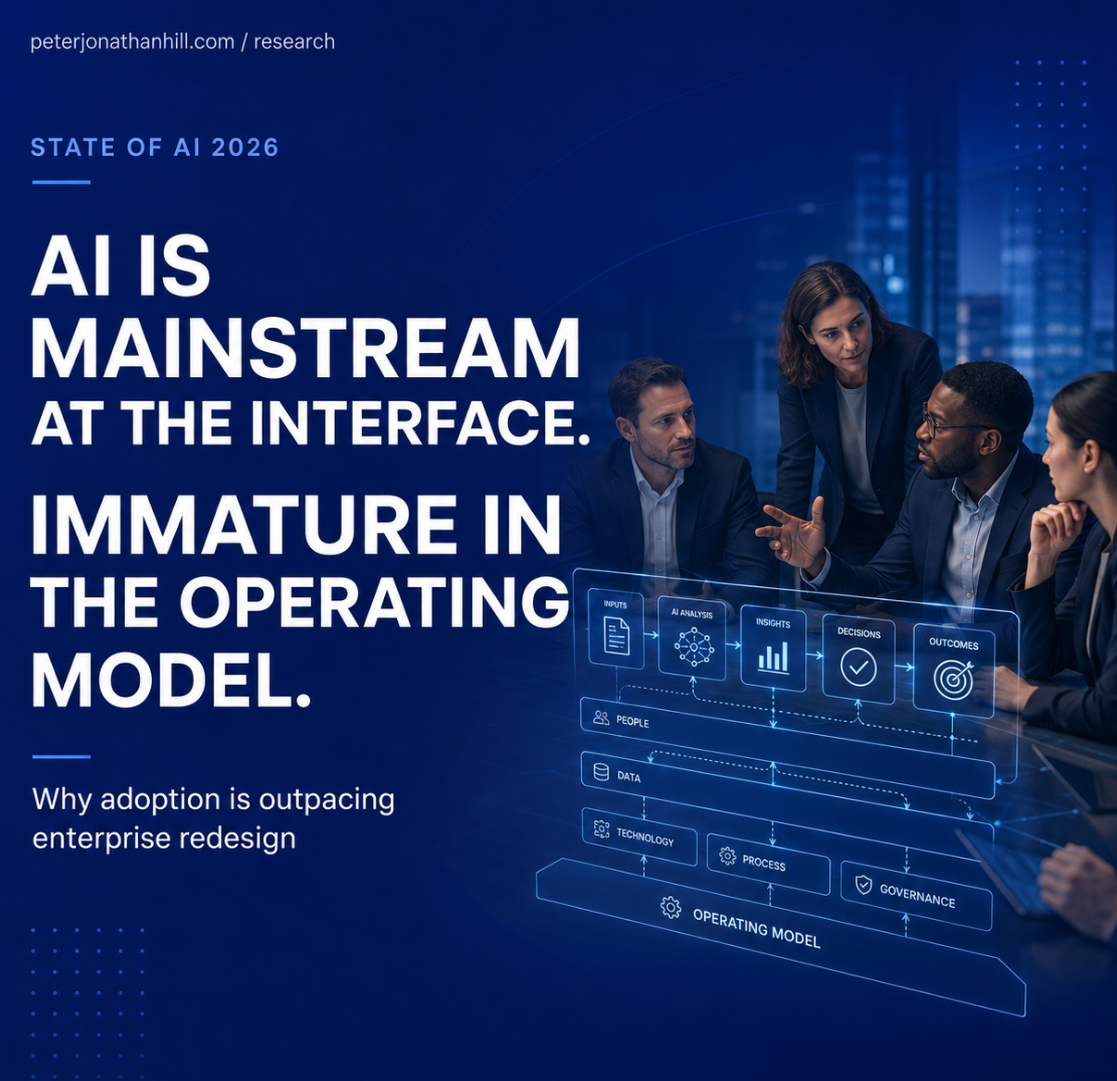
ChatGPT's launch converted frontier language models from an expert technology into a consumer behavior. The next four years moved AI from novelty, to copilot, to agent, to transformative business operating model.
Four phases since November 2022
1. Interface shock (2022-23) - Natural-language interaction made advanced model capability legible to almost anyone. ChatGPT reached an estimated 100M monthly users within two months and 100M weekly users by Nov. 2023. What enterprises learned: The adoption bottleneck was not training people to code; it was giving them a conversational interface.
2. Copilot proliferation (2023-24) - AI moved into office suites, search, software development, design and customer-service tools. What enterprises learned: Task-level assistance could be useful even when models were not reliable enough to own a process.
3. Reasoning + agents (2024-25) - Models became better at tool use, planning and multi-step execution. Coding moved from autocomplete toward repository-aware agents. What enterprises learned: Value rose when AI gained context, tools and permission to act - but failure modes became operational, not just textual.
4. System economics (2026) - Model performance is converging while enterprise scrutiny shifts to reliability, governance, inference cost, utilization and ROI. What enterprises learned: The best model is not automatically the best system. Architecture and organization increasingly determine realized value.
The remarkable part of the adoption curve is not simply speed. It is breadth.
ChatGPT's consumer scale created a distribution channel that enterprise software historically had to buy through sales and implementation. OpenAI reported more than 900 million weekly active users and 50 million subscribers by March 2026; by July it said its models served one billion active users and more than two million businesses. Enterprise revenue had risen above 40% of OpenAI revenue by March.
At the organizational level, Stanford's 2026 AI Index reports that 88% of surveyed organizations were using AI and 70% were using generative AI in at least one business function. Yet agent deployment was still in single digits across nearly all functions. This is the key adoption paradox: AI has become ubiquitous before autonomous AI has become routine.
ADOPTION PARADOX: The next stage of AI adoption is not primarily "more people using a chatbot." It is converting individual use into governed systems that change throughput, quality, cost, revenue or risk at the enterprise level.
Why diffusion was unusually fast
• No new hardware at the edge. A browser or phone was enough to access frontier capability.
• Low training cost. Natural language allowed users to discover use cases through conversation rather than formal workflow configuration.
• Immediate personal utility. Writing, synthesis, search, analysis, coding and image creation created value before enterprise integration was complete.
• Viral proof. Outputs were inherently shareable, which made adoption visible and socially self-reinforcing.
• Rapid price/performance improvement. Better models and falling inference cost continuously expanded the set of economically viable tasks.
What changes now: The consumer adoption curve will continue, but the strategic frontier has moved. Enterprises are now asking whether AI changes unit economics, whether agents can be trusted with state-changing actions, whether data-center capex can earn an adequate return, and whether people and organizations are developing the skills required to operate a human-machine system.
02 / FROM FRONTIER MODELS TO INFERENCE ECONOMICS
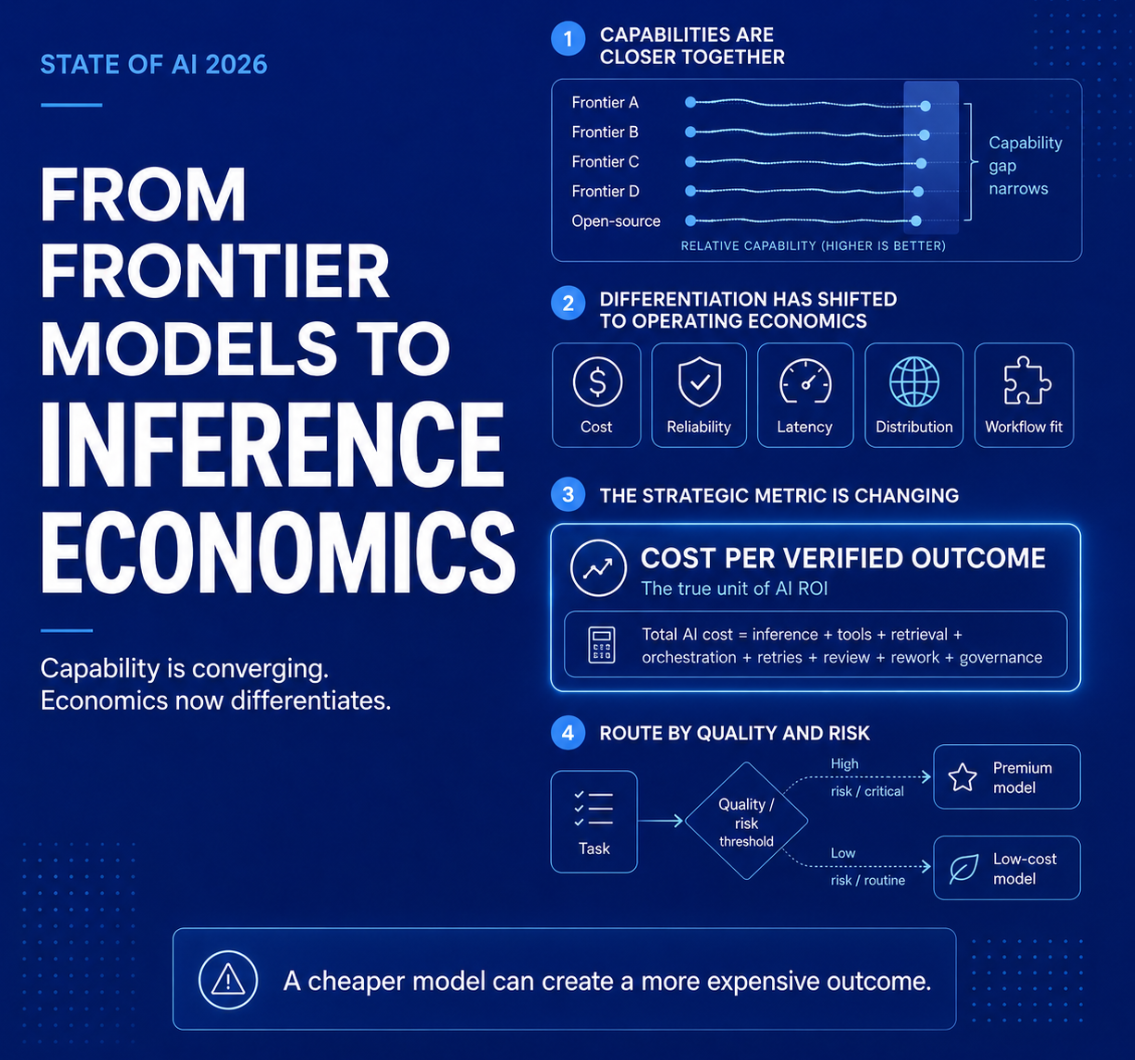
The frontier race continues, but top models are closer together. Economic differentiation is shifting toward cost, reliability, latency, distribution and workflow fit.
Stanford reports that Anthropic, xAI, Google and OpenAI were clustered within 25 Arena Elo points in March 2026, while Alibaba and DeepSeek also occupied the top tier. It explicitly notes that competitive pressure is shifting toward cost, reliability and domain-specific performance.
Capability is still advancing - but the economic question has changed:
Frontier performance is not plateauing. Stanford reports a 30-point one-year gain on Humanity's Last Exam and near-saturation of SWE-bench Verified. The important change is that raw benchmark leadership has become more transient and less sufficient as a business moat. A model can lead one evaluation and still lose a workload on latency, context handling, tool reliability, security, price or integration.
The strategic unit is shifting from "cost per token" to "cost per verified outcome."
GPT-3.5-equivalent cost per million tokens fell from $20 to $0.07 between November 2022 and October 2024 — an approximate 280× decline in inference cost. Meanwhile, annual inference-price declines observed across tasks in Stanford's 2025 Index ranged from 9-900×.
OpenAI's July 2026 GPT-5.6 engineering note is revealing because it treats efficiency as a system property: model design, inference serving, prompt caching, context management, tool use and the agent harness are optimized together. Terra is positioned at roughly GPT-5.5 intelligence at half the price, while Luna is priced far below the flagship tier.
A pragmatic ROI equation
COST PER VERIFIED OUTCOME: Total AI cost = model inference + tool/API calls + retrieval + orchestration + retries + evaluation + human review + rework + latency/opportunity cost + security/governance overhead. ROI = value of accepted business output - total AI system cost.
This matters because a cheaper model can be more expensive if it causes more retries, longer reasoning traces or more human correction. Conversely, a premium frontier model can be the lower-cost choice if it materially increases first-pass success on a high-value task. The rational architecture is therefore increasingly task-aware routing: use the least expensive model that meets a defined quality and risk threshold, and escalate when the expected cost of failure exceeds the model premium.
What this does to the model market
• Benchmark differentiation compresses. Model providers compete on the efficient frontier: capability per dollar, per watt and per second.
• Multi-model applications become normal. The application provider owns the customer experience and can route between models behind the scenes.
• Evaluation becomes infrastructure. Firms need reproducible, domain-specific tests to know when a cheaper model is actually good enough.
• Context engineering becomes a cost discipline. Long prompts and repeated tool traces can dominate spend; caching and state management become architectural concerns.
• Inference FinOps emerges. As agents run continuously, teams need budgets, spend alerts, per-workflow unit costs and chargeback mechanisms.
03 / THE RISE OF AGENTS
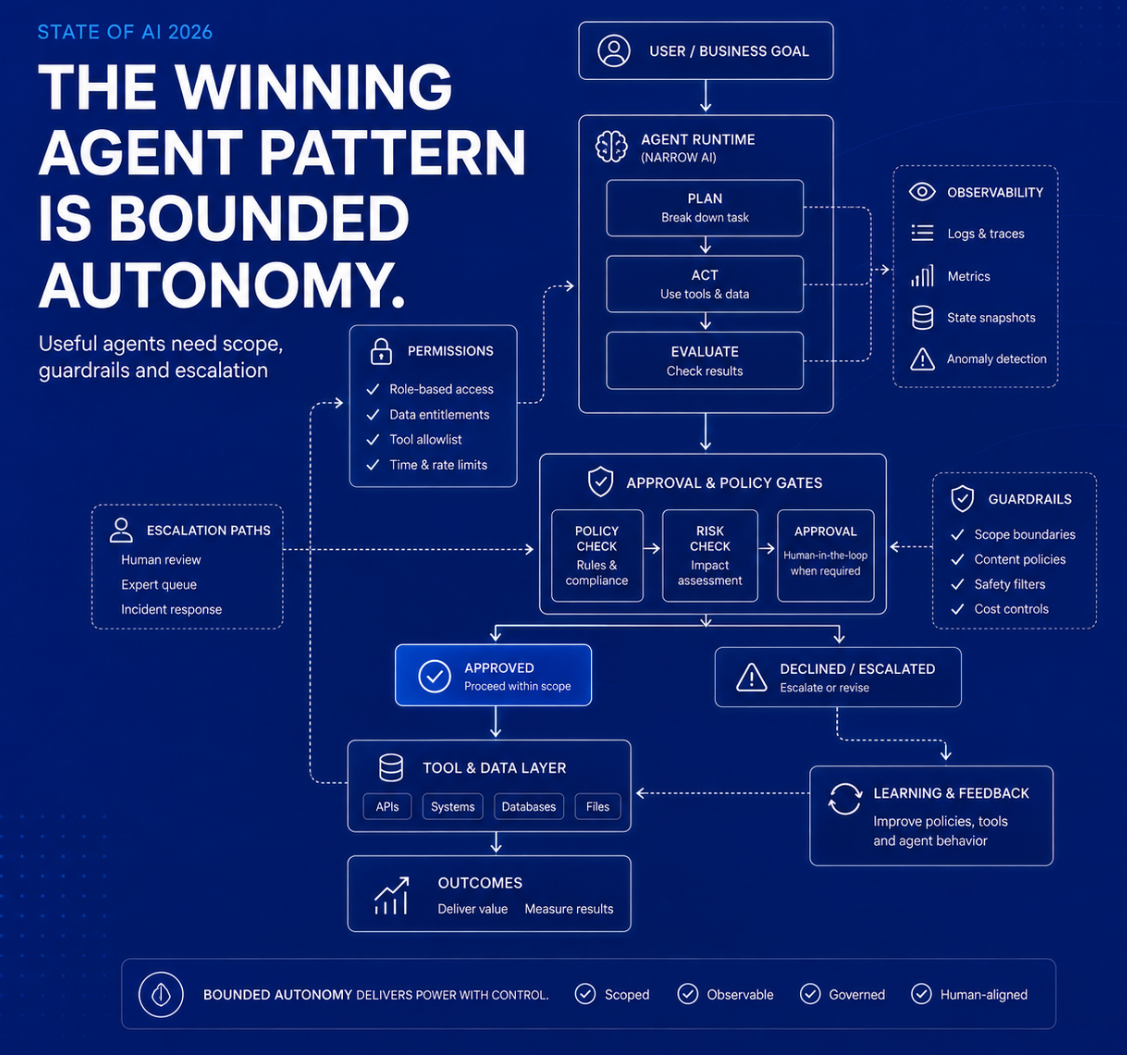
The agent transition is the move from generative output to state-changing action. That creates more value - and am entirely different risk model.
Key metrics: OSWorld agent accuracy during 2025 reached 66.3%, yet structured agent attempts still fail roughly one in three times. Gartner says 17% of organizations had deployed agents in 2026, with >60% expecting deployment within two years, yet >40% of agentic projects are forecast to be canceled by end-2027. McKinsey reports 62% of respondents at least experimenting with agents.
The word agent is now used for everything from a scripted chatbot to software that can plan, invoke tools, modify files, place orders, update systems of record and coordinate with other agents. The useful dividing line is not whether a product calls itself an agent; it is how much authority it has to change the world without a human choosing each step.
A practical agent maturity model
Level 0 - Assistant: Answers, drafts, summarizes. No independent action. Best 2026 use: Knowledge work, writing, analysis, search.
Level 1 - Tool user: Calls approved tools under close user direction. Best 2026 use: Data lookup, structured analysis, repetitive application actions.
Level 2 - Bounded agent: Plans and executes multi-step work inside a defined scope, with explicit permissions and checkpoints. Best 2026 use: Coding, support triage, operations, research workflows.
Level 3 - Workflow owner: Runs a process over time, handles exceptions, coordinates systems or subagents. Best 2026 use: Selective production use where failure is observable and reversible.
Level 4 - Open-ended autonomous actor: Pursues broad goals with wide permissions and limited oversight. Best 2026 use: Not appropriate for most enterprise workflows in 2026.
The winning agent pattern is bounded autonomy, not maximal autonomy.
Stanford's benchmark data and Gartner's adoption data point in the same direction. Agents have improved enough to become useful, but not enough to make broad reliability concerns disappear. NIST's 2026 review of agent-security comments found widespread agreement that agents introduce novel security threats and that traditional cybersecurity controls need adaptation.
Why agents fail in production even when the demo works
• Long-horizon compounding. A 95% success rate per step is poor across a 20-step workflow if errors are independent: expected end-to-end success is only about 36%.
• Tool and environment brittleness. APIs time out, schemas change, permissions differ and downstream systems contain unexpected state.
• Ambiguous objectives. Agents optimize the instruction they are given, which can be a weak proxy for the organization's real intent.
• Hidden failure. A system can continue operating after a subtle mistake, making detection later and more expensive than a visible exception.
• Authority risk. The more useful an agent becomes, the more access it needs - and the larger the blast radius of misuse, prompt injection or mistaken action.
• Economic loops. Agents can retry, spawn subagents and consume context in ways that make cost nonlinear.
What changes over the next 12-24 months: The label "agent" will matter less as agentic behavior becomes embedded into mainstream workflow design and build applications. Successful deployments will look less like digital employees roaming across the enterprise and more like workflow-native control loops: narrow authority, observable state, deterministic guardrails around probabilistic reasoning, explicit escalation, identity and authorization, and measurement against a business outcome.
04 / SOFTWARE DEVELOPMENT IS THE FIRST AGENTIC KILLER USE CASE
Coding is unusually well suited to agents because the work is digital, tool-rich, testable, version-controlled and economically valuable.
Key metrics: $4.0B Menlo estimate of 2025 enterprise coding-AI spend | $2.5B+ Claude Code run-rate revenue reported March 2026 | $2.0B Cursor annualized revenue reported Feb. 2026 | 90% Technology professionals using AI at work in DORA research | 20 hrs Average weekly Claude Code use in Anthropic sample | ~25% Increase in estimated typical task value in Anthropic's seven-month sample
From autocomplete to delegated engineering
The first generation of coding AI completed lines. The second generated functions. By 2025-26, coding agents could inspect repositories, plan a change, edit multiple files, run tests, use a shell, search documentation and iterate. Anthropic's longitudinal Claude Code analysis of roughly 400,000 sessions found debugging's share of sessions nearly halved over seven months while usage shifted toward more end-to-end tasks; the estimated value of the typical task rose about 25%.
Commercial adoption followed. Anthropic reported Claude Code run-rate revenue above $2.5B in March 2026, more than double its start-of-year level, with enterprise accounting for more than half. TechCrunch reported Cursor at a $2B annualized revenue rate in February 2026; the company's economics improved only after it introduced its own models and routed to cheaper models, illustrating that application growth does not automatically imply healthy gross margin.
Coding tools reveal both the promise and the hidden cost structure of AI.
DORA's 2026 analysis captures the central tension: initial code generation accelerates, but time savings are often reallocated to auditing and verification. Higher AI adoption was associated with both more throughput and more delivery instability. In other words, generation speed is not delivery speed.
METR's early-2025 randomized study offers an important counterexample to simplistic productivity claims: experienced open-source developers working in familiar repositories were 19% slower with the then-current AI tools, even though they believed they had become faster. That result is a snapshot of older tools and a specific population, but it demonstrates why perceived productivity is an unreliable KPI.
THE SOFTWARE LESSON: AI compresses the cost of implementation faster than it compresses the cost of deciding what should be built, specifying it, validating it and accepting responsibility for it.
Likely development operating model
Human advantage grows: Problem framing, architecture and trade-offs | Specification and acceptance criteria | Security, failure-mode reasoning and risk acceptance | Product judgment and user context | Review of novel or high-impact changes
AI advantage grows: Boilerplate implementation and repetitive edits | Repository search and pattern application | Test generation, refactoring and migration assistance | Parallel exploration of implementation options | Execution of well-specified changes with automated checks
The likely result is not "no engineers." It is fewer human minutes spent translating well-understood intent into syntax, and more organizational value placed on people who can specify systems, judge outputs and maintain quality as the amount of generated work increases.
05 / AI-NATIVE COMPANIES AND THE APPLICATION LAYER
Value is moving upward from model access toward products that own workflow, context, distribution and outcome measurement.
Menlo estimates enterprise generative-AI spend grew from $1.7B in 2023 to $37B in 2025. For the first time, the application layer slightly exceeded infrastructure: $19B versus $18B. Menlo counted at least ten products above $1B ARR and fifty above $100M ARR, with coding the largest departmental category.
What "AI-native" means economically
An AI-native company is not merely a SaaS company that adds a chat panel. Its product architecture assumes that model intelligence is part of the production system and therefore part of cost of goods sold, quality control and product iteration. The strongest AI-native businesses increasingly combine five assets: workflow ownership, proprietary context, model orchestration, evaluation data and distribution.
The best AI-native opportunities are high-frequency workflows with measurable outcomes.
Software engineering: High labor value; digital environment; tests and version control make outcomes observable. Representative 2026 players: Cursor, Claude Code, Codex, GitHub Copilot; specialized QA, SRE and review agents.
Enterprise knowledge + work orchestration: Large information-search burden; cross-system context is valuable; agents can move from answer to action. Representative 2026 players: Glean, enterprise copilots, AI workspaces and workflow agents.
Customer operations: Large volume; strong cost baseline; repeatable decisions; rich interaction data. Representative 2026 players: Sierra, Decagon, incumbent contact-center AI; escalation-aware agents.
Legal and regulated professional work: Expensive knowledge work; documents are structured enough for retrieval and review; willingness to pay is high. Representative 2026 players: Harvey and vertical legal/research platforms.
Healthcare administrative + clinical documentation: Enormous documentation burden and high workflow frequency; strong value if trust and compliance are solved. Representative 2026 players: Abridge and clinical documentation/workflow platforms.
Security and agent governance: AI expands machine identities, tool access and attack surface; demand rises with agent deployment. Representative 2026 players: Agent identity, authorization, runtime monitoring, AI red teaming and policy enforcement.
Voice, media and creative production: Native multimodality makes quality economically useful; iteration cycles are short. Representative 2026 players: ElevenLabs, Synthesia, Runway and model-backed creative systems.
Vertical operations: Industry-specific process knowledge can create data/network effects and higher switching cost than generic copilots. Representative 2026 players: Insurance, finance, logistics, industrial and scientific workflow platforms.
What will not be defensible for long: Thin wrappers around a third-party model face margin compression because model providers continuously add native features and model quality converges. Sustainable application value will come from being hard to remove from the workflow: owning the system of action, accumulating proprietary evaluation and outcome data, integrating deeply with systems of record, and becoming trusted enough to take responsibility for execution.
06 / WHO IS LIKELY TO GROW NEXT
The next 12-24 months favor scale at the model layer and specialization at the application layer. The middle is the most vulnerable.
Frontier-model provider outlook
OpenAI: Exceptional consumer distribution; expanding enterprise revenue; Codex and agent-first product strategy; enormous capital access. Primary risk: Capital intensity; pressure to convert mass usage into durable margins; strong enterprise/coding competition. 12-24 month view: Likely to remain the broadest consumer-to-enterprise AI platform.
Anthropic: Strong enterprise/API position; Claude Code is a breakout product; high credibility in coding and long-horizon knowledge work. Primary risk: Premium inference economics and dependence on continued enterprise differentiation. 12-24 month view: Likely to gain disproportionately in enterprise agents and software development.
Google: Top-tier model performance plus Search, Workspace, Android and Cloud distribution; internal silicon and infrastructure advantages. Primary risk: Product overlap and organizational complexity can slow coherent packaging. 12-24 month view: Strong probability of share growth as model performance converges and distribution matters more.
xAI: Top-tier technical performance in Stanford's March 2026 data; access to large compute and consumer distribution through X/SpaceX ecosystem. Primary risk: Higher execution, governance and enterprise-adoption uncertainty. 12-24 month view: Credible top-tier competitor; less predictable enterprise trajectory.
Chinese + open-weight ecosystem: U.S.-China model performance gap has effectively closed; open models pressure price and support sovereignty/local deployment. Primary risk: Geopolitics, enterprise trust and a reopened closed/open performance gap on some benchmarks. 12-24 month view: Likely to gain as routing options and cost anchors even where they do not own the end-user relationship.
Assessment: A long tail of frontier-model companies is hard to sustain because training and serving economics are capital intensive while top-tier performance is converging. The more likely equilibrium is a small number of global frontier labs plus a large ecosystem of specialized, open and regionally important models.
Application growth should be broader than model-provider growth.
Menlo's estimate that the application layer already captured $19B of enterprise spend in 2025 is strategically important. As model capability becomes an input that can be switched or routed, the application layer can capture value by owning the customer, workflow and acceptance criteria.
Most attractive application growth patterns
Coding / software creation (Very high): The category is already monetizing at multi-billion-dollar scale and continues expanding from code generation into planning, review, testing, SRE and product creation.
Vertical professional agents (Very high): Higher willingness to pay and better defensibility when the product contains domain logic, integrations, controls and proprietary workflow data.
Enterprise work / knowledge agents (High): Large addressable market, but success depends on becoming a system of action rather than a generic chat surface.
Agent security / identity / observability (High): Every increase in agent autonomy creates demand for authorization, audit, evaluation and policy enforcement. NIST already treats agent security as a distinct adaptation problem.
Consumer AI superapps (High but concentrated): Massive distribution effects favor a small number of platforms with memory, identity, search, commerce and action capabilities.
Generic model wrappers (Low / consolidating): Feature replication, falling model prices and native model-provider products erode differentiation.
Inference optimization and routing (High): Model convergence and price dispersion make multi-model routing, caching, serving and evaluation economically important.
VALUE MIGRATION: The model remains essential, but the durable profit pool increasingly sits where intelligence meets a workflow that somebody is willing to pay to complete.
07 / THE AI DATA-CENTER BUILDOUT
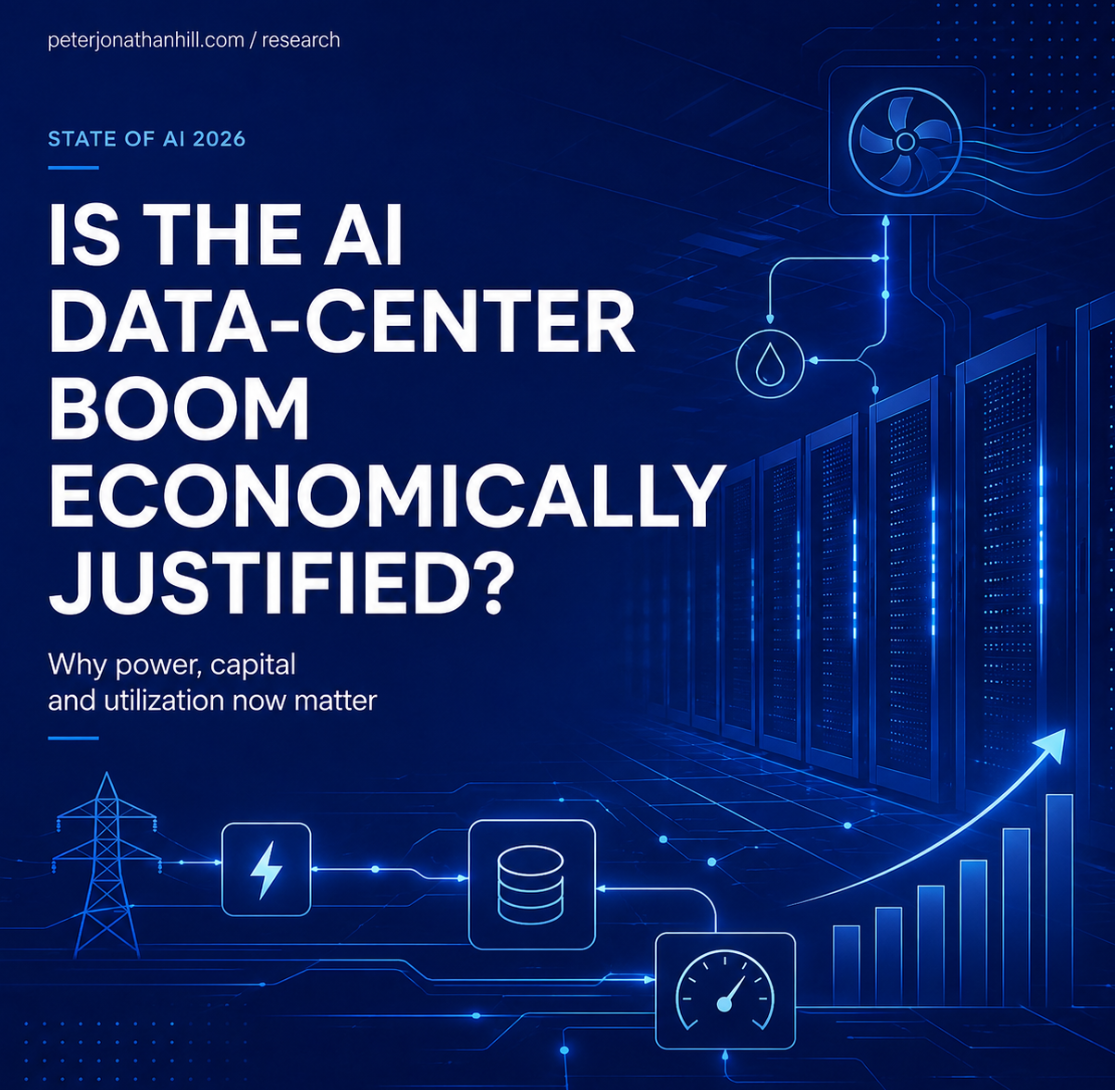
AI is a software transformation with unusually physical economics: power, land, cooling, networking, silicon, construction and long-lived capital all sit underneath each token.
The IEA estimates data centers consumed roughly 415 TWh of electricity in 2024 and projects about 945 TWh in 2030 in its base case. Electricity used by accelerated servers - the category most directly driven by AI - is projected to grow around 30% annually and account for almost half the net increase.
Stanford estimates global AI compute capacity grew 3.3× per year from 2022 to 2025, reaching 17.1 million H100-equivalents, and counts 5,427 data centers in the United States. Goldman Sachs Research said AI companies may invest more than $500B in 2026.
Why are AI data centers growing so much?
A common-sense explanation.
1. Training is large, but inference is becoming the continuous load: Training creates visible bursts of demand for the next frontier model. Inference is the structurally larger long-run opportunity because every user interaction, agent action, coding session, search, generated image and business workflow invokes compute repeatedly. As adoption expands and agents run longer tasks, the number of model calls per useful outcome can rise dramatically.
2. Cheaper intelligence can increase total compute demand: A 280× reduction in the price of a given level of intelligence does not imply a 280× reduction in infrastructure needs. It makes many more tasks economically viable. This is the classic Jevons-effect pattern: efficiency lowers the cost of a unit, which stimulates demand for many more units. OpenAI describes a similar flywheel: cheaper delivery makes more complex workflows viable, which increases usage and therefore compute demand.
3. AI workloads are denser than traditional cloud workloads: Accelerators concentrate much more power per rack and require faster interconnects, liquid cooling and large contiguous power blocks. The physical bottleneck is increasingly not the server itself but the ability to deliver megawatts or gigawatts of reliable power and remove the resulting heat.
4. Infrastructure has long lead times: The IEA notes that a data center may be operational in two to three years while the broader energy system takes longer to plan and build. Companies therefore must commit capital against expected future demand before that demand is fully visible.
Is the buildout economically justified?
Partly - but the distribution of returns matters more than the aggregate.
THE RIGHT QUESTION: Do not compare one year of AI software revenue directly with one year of data-center capex. Capex buys an asset that should produce revenue for years. The economic question is whether lifetime utilization and gross profit justify the capital, power and financing cost before the hardware becomes obsolete.
A five-test economic sanity check
Demand: Is there evidence of sustained utilization, not just reservations? 2026 assessment: Strong at leading hyperscalers and model providers; less transparent for speculative capacity.
Unit economics: Does revenue per unit of compute rise faster than fully loaded serving cost falls? 2026 assessment: Improving, but application margins vary widely; Cursor's reported journey from negative to slight gross-margin profitability is illustrative.
Asset life: Can the facility remain useful through multiple accelerator generations? 2026 assessment: Buildings, power and cooling can; GPUs depreciate technologically much faster.
Capital structure: Can the owner survive periods of lower utilization or price compression? 2026 assessment: Hyperscalers have an advantage; debt-funded single-purpose projects carry more downside. Goldman notes investors already distinguish between these models.
Location / power: Is the site connected to durable low-cost power and network capacity? 2026 assessment: Increasingly decisive. Local grid bottlenecks can matter more than global electricity share.
Bottom line: The aggregate direction - significantly more AI infrastructure - is economically credible. The proposition that every announced project will earn an attractive return is not. A likely 2027-28 story is continued headline capex paired with widening dispersion between highly utilized strategic capacity and projects that are delayed, repriced, refinanced or repurposed.
08 / WHERE AI SITS ON THE HYPE / ADOPTION CURVE
AI should not be placed at one point on one curve. The technology stack is decomposing into mature, over-hyped and newly productive layers at the same time.
Gartner explicitly places agentic AI at the Peak of Inflated Expectations: only 17% of organizations had deployed agents, while more than 60% expected to do so within two years. It also forecasts that more than 40% of agentic projects could be canceled by the end of 2027 because of cost, unclear value or inadequate controls.
The useful interpretation is a portfolio of curves
Consumer chat / generic GenAI: Moving through expectation reset toward utility. Implication: Adoption is no longer the issue; differentiation shifts to memory, search, action, multimodality and distribution.
Coding agents: Early slope of enlightenment. Implication: Real revenue and embedded daily use exist; the challenge is system-level quality and review economics.
General enterprise agents: Peak of inflated expectations. Implication: Expect canceled pilots, vendor consolidation and a move toward bounded workflow agents.
Vertical AI applications: Early slope, uneven by domain. Implication: The strongest categories can compound proprietary workflow and outcome data.
AI data-center investment: Capital boom ahead of fully proven lifetime returns. Implication: Buildout continues because of lead times, but utilization and free-cash-flow scrutiny intensify.
Frontier models: Still rapid technical progress, weaker benchmark moat. Implication: Competition shifts to cost, reliability, safety, ecosystem and distribution.
09 / ENTERPRISE ROI: THE VALUE GAP IS ORGANIZATIONAL
AI tools can make individuals faster without making the enterprise more profitable. The missing layer is often workflow and organizational design.
Key metrics: 66% Deloitte respondents reporting productivity / efficiency gains | 40% Reporting cost reductions | 20% Reporting revenue gains | 39% McKinsey respondents reporting enterprise-level EBIT impact | ~2/3 McKinsey organizations not yet scaling AI enterprise-wide | 2× Microsoft: organizational factors explain >2× the reported AI impact of individual factors
Deloitte's 2026 survey of 3,235 leaders captures the ROI transition well: two-thirds report productivity or efficiency gains and 40% report cost reduction, but only 20% report revenue gains even though 74% aspire to them. McKinsey similarly finds enterprise-level EBIT impact in only 39% of organizations despite widespread experimentation.
Why local productivity disappears before it reaches the P&L
• The bottleneck moves. Faster analysis or code generation simply pushes more work into review, approval, integration, sales or another constrained step.
• Saved time is not automatically monetized. Employees may use it for more work, higher quality, shorter days or simply more communication. Only some of those outcomes create measurable profit.
• Legacy process remains. If AI sits on top of the old approval chain, the organization pays for the new tool while preserving the old operating cost.
• Quality externalities appear downstream. More generated output can increase review, maintenance or governance burden.
• Metrics are too local. "Prompts sent," "licenses activated" or "hours saved" are adoption indicators, not business outcomes.
ROI must be measured at the system boundary, not the user interface.
A better measurement hierarchy
User level: Weak metric: Prompts, active users. Better metric: Time to accepted output; quality; skill retention.
Workflow level: Weak metric: Tasks automated. Better metric: End-to-end cycle time; exception rate; cost per completed case.
Function level: Weak metric: AI licenses. Better metric: Throughput per FTE; customer outcomes; error/rework; capacity released.
Enterprise level: Weak metric: Hours "saved". Better metric: EBIT impact; revenue growth; working capital; risk reduction; strategic option value.
The most important architectural move is to make the definition of "done" machine-readable enough to evaluate. Inference cost matters, but the more expensive failure mode is producing large volumes of output that the organization cannot confidently accept, and which potentially erodes customer trust.
2026 ROI PRINCIPLE: The economic value of AI is determined less by how cheaply it can generate an answer than by how cheaply the organization can trust, integrate and act on those answers.
10 / AI TRANSFORMATION IS ORGANIZATIONAL REDESIGN
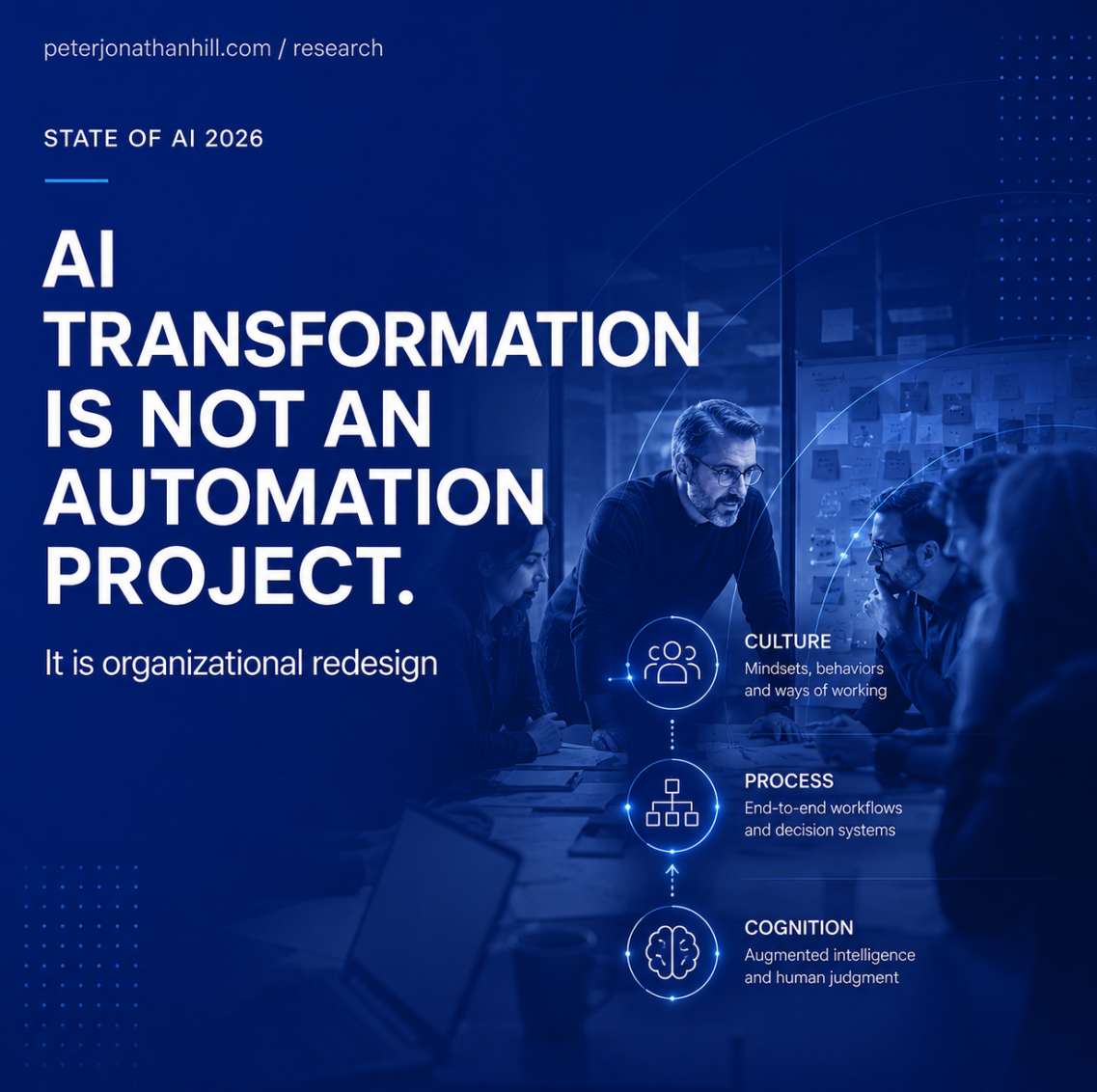
The deeper transformation is a redesign of how cognitive work is allocated across people, software and machines.
A technology-led AI program typically starts with use cases: Where can we deploy a copilot? Which process can we automate? Which model should we buy? Those are useful questions, but they can be premature. An AI system can automate work that should not exist, accelerate a broken process, embed a weak decision rule or remove a human interaction that was central to the organization's identity.
The earlier article AI Transformation is not an Automation Project, it is an Organizational Redesign proposes three connected maps before automation decisions are finalized: process mining asks "What do we do?", culture mining asks "Who are we?", and cognitive mining asks "How do we think?"
The three maps: Process. Culture. Cognition.
Process: What work actually happens, where does it wait, and what creates value? AI transformation decision: Eliminate, simplify, redesign, automate or preserve each activity.
Culture: What behaviors, relationships and brand qualities define how the organization acts? AI transformation decision: Decide what should evolve and what must not be accidentally automated away.
Cognition: Where do information, judgment, decision and accountability live? AI transformation decision: Define why humans remain, what unique capability they contribute and how AI changes the division of cognitive labor.
The maps only become useful when read together.
Consider customer-support triage. Process analysis may show that classification and information retrieval are ideal for agents. Culture analysis may show that personal responsiveness is a core part of the company's brand. Cognitive analysis may show that emotionally sensitive or financially consequential cases require human judgment and accountability. The result is not "automate support" or "keep humans." It is a redesigned operating model in which AI handles volume and humans are deliberately concentrated where human interaction creates disproportionate value.
What AI changes structurally
Old organizational assumption: Headcount is the main scalable source of cognitive throughput. AI-era pressure: Inference can add cognitive throughput without adding people, but requires control and verification.
Old assumption: Information scarcity justifies layers of coordination and reporting. AI-era pressure: AI can synthesize and route information continuously, reducing some coordination work.
Old assumption: Expertise is partly demonstrated by producing the artifact. AI-era pressure: Value moves toward framing, judgment, originality, accountability and the ability to distinguish good from plausible.
Old assumption: Processes can tolerate ambiguity because experienced people compensate for it. AI-era pressure: Agents expose ambiguity; specifications, policies and acceptance criteria become executable infrastructure.
Old assumption: Managers allocate and monitor human work. AI-era pressure: Managers increasingly design human-agent systems, decision rights, controls and feedback loops.
Old assumption: Culture changes slowly and indirectly. AI-era pressure: AI can change who customers interact with, how decisions are made and what behaviors get rewarded - therefore changing culture through system design.
Culture is not a soft side issue. It is part of the production system.
Microsoft's 2026 Work Trend Index surveyed 20,000 AI users and analyzed large-scale productivity signals. It found organizational factors such as culture, manager support and talent practices accounted for more than twice the reported AI impact of individual factors. Only 26% of surveyed AI users said leadership was clearly and consistently aligned on AI.
This explains why tool-first transformation often disappoints. The employee is asked to reinvent work while being measured against the old process, old role definition and old risk model. Microsoft calls this a "Transformation Paradox": the pressure to use AI increases while incentives continue to reward execution of the existing system.
Organizational design changes likely to accelerate
• Smaller execution units. A team with strong domain judgment and agent leverage can perform work that previously required more specialized handoffs.
• Fewer coordination layers in some functions. AI can aggregate status, trace dependencies and synthesize decisions continuously; coordination roles must move toward judgment and system design to remain valuable.
• More explicit decision rights. Organizations will need clear boundaries for what agents may decide, what humans must approve and who owns failures.
• Talent ladders redesigned. Entry-level work that once taught the basics may be automated first, forcing companies to create deliberate apprenticeship and skill-building mechanisms.
• Quality and evaluation become cross-functional. Product, program, engineering, risk and domain experts increasingly share ownership of specification and acceptance criteria.
• AI fluency becomes managerial, not only technical. Leaders need enough understanding of model behavior and agent economics to design work, not necessarily to build models.
11 / WORK, TALENT AND THE CHANGING VALUE OF EXPERTISE
AI is not producing a single labor-market effect. It is separating tasks that can be democratized from roles where AI makes expert judgment more valuable.
PwC's 2026 AI Jobs Barometer describes a two-track labor market. Companies in the most AI-exposed sectors had stronger headcount and wage growth than the least exposed; jobs requiring AI skills grew much faster than the overall job market and carried a large wage premium. In U.S. data, AI-exposed entry-level roles were seven times more likely to ask for traditionally senior capabilities such as judgment and leadership.
EXPERTISE PARADOX: AI lowers the cost of producing expert-looking output at the same time that it raises the value of genuine expertise required to know whether that output is right.
This is why "AI democratizes expertise" is only half true. It democratizes access to a competent first attempt. In high-stakes work, the scarce resource becomes calibrated judgment: recognizing edge cases, interrogating assumptions, knowing when evidence is weak, understanding political or human context, and taking responsibility for the decision.
Likely workforce effects
Routine cognitive production: Expected AI effect: Substantial automation / compression. Human value that remains / grows: Exception handling, quality control, relationship context.
Expert analysis / Software implementation: Expected AI effect: Strong augmentation / High agent leverage. Human value that remains / grows: Problem framing, causal reasoning, calibration, accountability / Architecture, specification, integration, security, review.
Management coordination / Creative production: Expected AI effect: Automation of reporting and information routing / Much cheaper generation. Human value that remains / grows: Priority setting, conflict resolution, organizational design, motivation / Taste, direction, originality, brand judgment, selection.
Entry-level knowledge work: Expected AI effect: Highest disruption risk to apprenticeship tasks. Human value that remains / grows: Deliberate skill building, supervised exposure to difficult cases.
12 / AI AND HUMAN COGNITIVE ABILITY
The cognitive risk is not that using AI automatically makes people less intelligent. It is that repeated delegation can remove the practice through which judgment, memory and expertise are formed.
Key metrics: 319 Knowledge workers in Microsoft/CMU critical-thinking study | 936 Real work examples in that study | 17% lower Mastery score for AI-assisted learners in Anthropic coding RCT | 54 Participants in MIT Media Lab sessions 1-3; exploratory EEG study | 52 Mostly junior engineers in Anthropic skill-formation RCT | 19% slower Early-2025 METR result for experienced developers on familiar repositories
Microsoft Research and Carnegie Mellon found that higher confidence in generative AI was associated with less self-reported critical-thinking effort, while higher confidence in one's own task ability was associated with more. Importantly, critical thinking did not simply disappear; it shifted toward verification, integration and stewardship of AI output.
Anthropic's January 2026 randomized coding study found participants using AI scored 17% lower on a mastery quiz after learning a new Python library, with the largest gap in debugging. But the interaction pattern mattered: participants who asked conceptual questions or generated code and then worked to understand it retained more.
MIT Media Lab's 2025 essay-writing study reported lower EEG connectivity, recall and ownership for the LLM group than the brain-only group. Its small sample and preprint status mean it should be treated as a signal rather than a settled conclusion. A 2026 systematic review similarly characterizes generative AI as both a potential cognitive scaffold and a source of over-reliance depending on how it is used.
The right distinction is not "AI use" versus "no AI." It is cognitive substitution versus cognitive amplification.
Four modes of AI use
Delegation: Asks AI to produce the answer and accepts it. Cognitive effect: High short-term speed; highest risk of weak learning, poor calibration and hidden error.
Verification: Reviews AI output against known criteria. Cognitive effect: Efficient for experts; weak if reviewer lacks the knowledge or time to evaluate meaningfully.
Collaboration: Uses AI to explore options, challenge assumptions, explain reasoning and iterate. Cognitive effect: Can expand search space while preserving active judgment.
Tutoring / deliberate practice: AI asks questions, gives hints, explains and withholds complete solutions when appropriate. Cognitive effect: Most promising pattern for combining access with skill development.
Enterprise safeguards for cognitive capability
• Protect cognitive reps. Identify which skills require practice to remain available during outages, exceptions and oversight.
• Separate learning mode from production mode. Maximum delegation is rational for mastered repetitive work; it may be destructive when someone is still building the mental model.
• Require explicit verification for consequential outputs. The human reviewer must have time, information and authority; otherwise "human in the loop" is theater.
• Use teach-back. For important work, ask the human to explain the logic, assumptions and failure modes rather than merely approve the artifact.
• Measure expertise retention. Track diagnostic ability and independent performance, not only AI-assisted throughput.
• Design adaptive AI interfaces. Future systems should introduce friction when learning matters and remove it when execution efficiency is the goal.
13 / 12-24 MONTH OUTLOOK: AUGUST 2026 TO AUGUST 2028
The base case is continued rapid capability improvement combined with much tougher economic and organizational selection.
High-confidence predictions
• Agent projects consolidate around narrow workflows and bounded authority. Gartner's peak-hype signal, current failure rates and security constraints favor smaller blast radii.
• Coding agents become a default SDLC surface, not an optional tool. Revenue, usage and workflow depth are already at scale; the remaining shift is organizational standardization.
• AI budgets move toward cost per outcome, with inference FinOps and evaluation becoming standard. Model convergence and huge usage growth make token price alone inadequate.
• Application-layer spend grows faster than the number of viable frontier-model vendors. Application spend already exceeds infrastructure in Menlo's model; workflow specialization has far more categories than frontier training can economically support.
• Multi-model routing becomes normal in serious AI products. Top-model performance is converging while cost, latency and domain performance differ.
• Data-center investment remains high through 2027, but capital markets punish weak utilization and debt-heavy economics. Projects have long lead times and demand is rising, while investor differentiation is already visible.
• AI transformation shifts from "use cases" to operating-model redesign. Enterprise ROI and Microsoft's organizational evidence both point toward system-level constraints.
• Talent systems begin explicitly protecting skill formation. Automation is removing apprenticeship tasks while research shows learning trade-offs from heavy delegation.
Medium-confidence predictions and wildcards
• OpenAI, Anthropic and Google remain the three most economically important Western frontier-model platforms (Medium-high confidence). What would invalidate it: A major technical discontinuity, regulatory break, distribution shock or open-model cost collapse.
• Agent security / non-human identity becomes a major enterprise cybersecurity buying category (Medium-high confidence). What would invalidate it: If broad agent deployment remains confined to application sandboxes with minimal privileges.
• Outcome-based AI pricing grows relative to SaaS seat pricing in automatable workflows (Medium confidence). What would invalidate it: If inference cost volatility and output quality make vendors unwilling to absorb execution risk.
• Some data-center projects are delayed, repriced or repurposed without causing an "AI bust" (Medium-high confidence). What would invalidate it: If inference demand consistently outruns even aggressive capacity additions and financing remains cheap.
• The first serious AI productivity backlash centers on review overload and cognitive debt, not model capability (Medium confidence). What would invalidate it: If automated evaluation and provenance improve faster than generated output volume.
• Management spans widen in functions where agents automate reporting and coordination (Medium confidence). What would invalidate it: If coordination complexity grows as fast as agent leverage, preserving current managerial layers.
• Open and Chinese models become increasingly important as routing options and sovereign deployments (Medium-high confidence). What would invalidate it: A durable performance gap or policy restrictions that prevent enterprise adoption.
Downside scenario: "the mini-trough" A plausible 2027 downside is not that AI stops working. It is that expectations for autonomous agents and infrastructure returns reset simultaneously: agent projects are canceled, data-center utilization is questioned, some AI application gross margins disappoint and companies realize that organization redesign takes longer than model adoption. This would look like a financial and managerial trough of disillusionment while underlying model capability and useful deployment continue to improve.
Upside scenario: "verified autonomy" The upside case is a rapid improvement in agent reliability, automated evaluation and tool security. If systems can prove what they did, constrain permissions, recover from errors and cheaply verify outcomes, the economic value of agents expands nonlinearly because human review ceases to be the dominant bottleneck.
14 / THE EXECUTIVE AGENDA
The central leadership task is to redesign the organization so increasingly cheap intelligence produces valuable outcomes without eroding trust, accountability or human capability.
Ten decisions every leadership team should make now
1. Define the outcomes: Which 5-10 enterprise outcomes are important enough to redesign work around, rather than simply add AI to?
2. Map the work: Where does value actually flow, where does it wait, and which work should disappear before automation?
3. Map cognition: Where does data become judgment, judgment become decision and decision become accountability?
4. Set agent authority: Which actions are read-only, reversible, approval-gated or prohibited? Who owns agent identity and authorization?
5. Build acceptance tests: How will the organization determine whether an AI output is good enough to act on without expensive manual review?
6. Measure end-to-end economics: What is cost per verified outcome, including rework, review and failures - not only model spend?
7. Adopt model routing: Where is frontier capability necessary and where can lower-cost models satisfy the quality threshold?
8. Redesign talent systems: Which apprentice tasks are disappearing and how will future experts acquire the judgment needed to supervise AI?
9. Protect culture and brand: Which human interactions create trust or identity and should become more, not less, deliberate as automation expands?
10. Govern as a learning system: How will the organization continuously compare AI performance, incidents, economics and human outcomes and revise the design?
FINAL THESIS: AI advantage will not come from deploying the most agents or buying the most compute. It will come from designing the clearest system for turning machine intelligence into outcomes trusted by customers, while preserving the human capabilities that remain essential.
METHODOLOGY AND INTERPRETATION
How to read this report
This paper synthesizes current research, market estimates and company-reported operating metrics available through 7 August 2026. It is designed as a strategy document, not a comprehensive catalog of every model or vendor. It gives greater weight to primary company disclosures, institutional research, large surveys and peer-reviewed work, while using market reporting where private-company economics are otherwise unavailable.
Evidence types
Observed / reported: Directly reported metrics, benchmark results, surveys or empirical studies. Company-reported data is identified as such where material.
Estimated market data: Third-party market-sizing such as Menlo Ventures. Useful directionally, but methodologies and sampling can differ from audited financial data.
Synthesis: Interpretation that combines multiple sources - for example, the layered AI hype curve and the economic assessment of data-center buildout.
Forecast: 12-24 month judgments. Confidence reflects the strength of current evidence, not a statistical probability model.
Limitations
• AI capability, pricing and usage can change materially within weeks. This report is intentionally date-stamped.
• Benchmark performance is not equivalent to enterprise reliability; Stanford itself notes benchmark saturation, invalid questions and gaming concerns.
• Private-company revenue figures and market-share estimates may be self-reported or based on third-party sources.
• Organizational surveys often measure self-reported outcomes and association, not causation.
• Cognitive-impact research is early. The most alarming results should be interpreted as evidence to design better usage patterns, not proof of permanent cognitive harm.
The organizational-transformation analysis also incorporates the author's published framework, "AI Transformation Is Not an Automation Project. It Is an Organizational Redesign," as a conceptual lens rather than an independent empirical source.