
article
The State of Agentic AI in Program Management: What the Platforms Have Already Built (and What You Should Build Yourself)
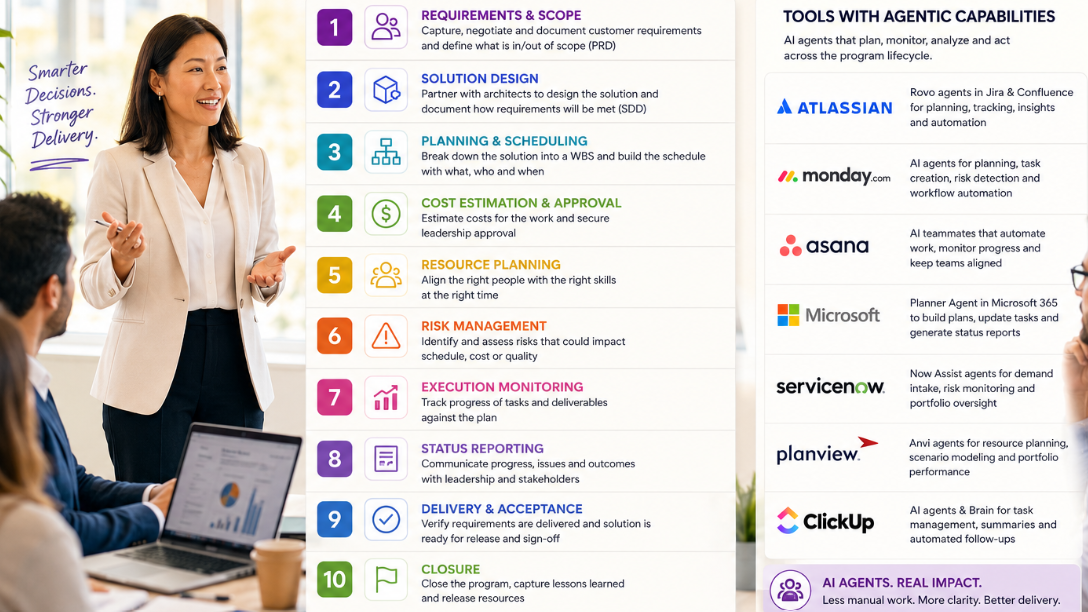
If you manage programs or projects for a living, you've probably noticed that the AI conversation changed sometime in the last year. It stopped being about a chat box that summarizes a page and started being about agents that hold a specific role within the project, watch a workflow, and do more complex work alongside you.
That shift is real, and it's happening across every platform you likely already use. I spent some time mapping what the major vendors have actually shipped, what the adoption data says, and how it lines up against the ten key things a program manager typically does.
The one-line takeaway
The platforms have already built most of the agent capabilities a PMO would want. The key value in 2026 isn't probably building agents from scratch - although that is clearly a key added value skill for ambitious PMs — it's in adopting the proven ones quickly, understanding how to configure more complex agents, and building only where there is a proven need.
Where the market actually is
The framing debate is over. As Forbes put it back in January 2026, for most organizations the question is no longer whether to use AI agents — "that debate is already over." The numbers explain why every vendor is moving at once:
Gartner forecasts worldwide AI spending will hit $2.52 trillion in 2026, up 44% year over year.
Yet only about 17% of organizations have actually deployed AI agents so far — while 60%+ expect to within two years. That's one of the steepest intent curves Gartner tracks.
Program and project management is a leading use case: a widely-cited Gartner projection has 78% of enterprise IT project teams deploying at least one AI-driven PM tool in 2026.
One important caveat, because a credible case for the use of agent AI has to include it: Gartner also expects roughly 40% of agentic AI projects to be canceled by the end of 2027. In-house builds fail at especially high rates. This technology is real, but scope discipline matters more than ambition and using AI agents just because they are available.
What the major platforms are shipping
This was the question I most wanted to answer: are enterprises stitching this together ad hoc, or are project management product companies building it in meaningfully? It's clearly the latter. Every category leader now has a named agent platform.
Atlassian — Rovo. Arguably the furthest along in treating agents as first-class citizens, and also the one I have most first-hand experience with. Rovo spans Search, Chat, Studio, and Agents, embedded across Jira and Confluence and sitting on a "Teamwork Graph" that connects Atlassian and third-party data. Atlassian reports Rovo across 3M+ users and even runs a dedicated agent conference. With the right permissions, PMs can build their own no-code agents to automate status updates and compile reports. One proof point: HarperCollins reported testing Rovo agents to reduce manual project work by around 4x.
Asana — Agentic Work Management. Asana has repositioned its entire product as an "Operating System for Human-Agent Teams." The stack combines AI Teammates (agents that hold a role on a project), AI Studio (a no-code builder for rule-driven workflows), Asana Dash, and connectors. Its May 2026 acquisition of StackAI extends agents beyond Asana's own data into external databases, CRMs, and tech stacks.
Monday.com — AI Work Platform. Built from AI Blocks (drop-in AI steps inside any workflow), digital workers (agents that own recurring work), and a no-code app builder. The PM messaging centers on portfolio visibility, smart resource allocation, and predictive analytics — agents handling project-health monitoring, meeting prep, and follow-ups around the clock.
Microsoft — Planner Agent. Microsoft folded its "Project Manager Agent" into Planner, renamed it the Planner Agent, and took it to general availability on June 15, 2026. It creates plans from a stated goal, generates and updates tasks, and pulls context from meetings, emails, and chats across Microsoft 365 — a strong fit if your organization already prioritizes working in Teams, Outlook, Word, Powerpoint and Excel.
One honest limitation worth repeating, because it applies across all vendors: independent 2026 reviews found Microsoft's agent excels as a research assistant and project summarizer for basic plans, but "struggles with complex, data-driven PM work." In my opinion, that's the current frontier everywhere. Agents are strong at synthesis, drafting, and monitoring, because that is what their underlying LLMs do best — but weaker at rigorous estimation, dependency math, and multi-variable optimization. However, given how fast AI changes, expect that to change.
ServiceNow — agents plus governance. ServiceNow builds agents natively on its Now Platform, but its more distinctive 2026 move is on governance: an AI Control Tower (integrated with Microsoft's Agent 365) designed to discover, inventory, and govern AI agents across an enterprise. That's a preview of the next problem after adoption — managing a sprawl of agents — and worth noting in any multi-year plan.
The platform landscape at a glance
Atlassian (Rovo): No-code agents for status updates and reports, with deep Jira/Confluence context. Best fit if you're on Jira or Confluence. APIs are simple to integrate with vibe-coding tools such as Cursor, Codex or Claude Code. Given Jira's large existing presence in the enterprise software market, this may be the logical choice for many technology organizations.
Asana (Agentic Work Management): Role-holding agents, smart workflow automation, external connectors via StackAI. Best fit if you're on Asana.
Monday.com (AI Work Platform): Portfolio visibility, resource allocation, health monitoring, follow-ups. Best fit if you're on Monday. Some users might find the Monday interface a bit simplistic, perhaps being better for smaller, independent teams rather than an organization with dozens of different teams delivering hundreds of features.
Microsoft (Planner Agent): Plan-from-goal, task generation, meeting/email-to-task capture (GA June 2026). Likely the best fit if you're on Teams / Planner / Microsoft 365 in a complex organization where project communication is heavily email and Office document centric.
ServiceNow (Now Platform + AI Control Tower): Enterprise workflow agents plus agent governance and inventory at scale. Best fit if you're on ServiceNow or managing a large IT estate.
The ten PM functions vs. what's actually ready
Here's the part that turns all of this into a decision. I took the ten functions a program manager typically owns across the lifecycle of a program, and scored each one on how mature and proven the capability is across shipping products today — not whether it's theoretically possible.
High readiness — turn these on first:
Planning & work breakdown — Plan-from-goal and task generation in Planner, Asana, and Monday. Building a detailed plan from discussions with a team and a requirements or design specification document is often a big job for program managers. Accelerating that process is likely all upside.
Execution monitoring & delivery — Project-health monitoring and status tracking are core to every platform, and the ease of vibe-coding with API access to data sources now makes the ability to build a custom dashboard a competency within the reach of every program manager.
Executive reporting & insights — The single most proven use case: status roll-ups, rule based wording for executive summaries and status reports, and narrative reports that synthesize data across multiple different programs or entire portfolios are where LLMs excel.
Medium readiness — configure rather than build:
Requirements & scope (PRD) — Meeting-to-doc summarization is strong; conflict and ambiguity detection are emerging. LLMs are great at creating PRD’s provided Product Managers have skills at setting context, guardrails and structure in their AI prompting and skill configuration.
Resource planning & capacity — Smart allocation exists, but accuracy depends on clean HR and skills data. Increased AI use may even prompt organizations with more informal resource management approaches to tighten their approach to increase validity of AI driven output.
Risk identification & mitigation planning — Continuous scanning and flagging are shipping; genuine prediction with proposed mitigations still maturing. Skilled prompting or thoughtfully built agents with clear boundaries and conditions may still yield actionable risk warnings or information.
Requirements validation / release readiness — Traceability checks exist in dev toolchains; PRD-to-test coverage is partial. Tying requirements right through to code delivery and production release tracking is still evolving and may require deeper structural change about how the organization manages work end to end. Whether a product is really ready to ship should always still involve a human in the loop.
Project closure & knowledge capture — Retrospective and doc synthesis are feasible now; financial and HR closeout stays bespoke.
Emerging — human-led, AI-assisted:
Solution design review — Requirement-to-design traceability is still largely bespoke and least covered by PM platforms. This is one area where ‘human in the loop’ needs to stay in focus. Senior engineering staff may find their role shifts to sanity checking AI created solution documents, rather than guiding the design process itself.
Cost estimation & financial planning — The weakest area for agents today. This is exactly the "complex, data-driven work" they struggle with and where human context setting and decision-making is deeply embedded. Keep a person accountable.
Build vs. buy: the decision that actually matters
Because the platforms have built so much, the sharpest question isn't which functions to automate — it's how to source them. The 2026 consensus, across analyst and practitioner writing, is a hybrid: decide on which platform to buy, then build narrowly on top of it.
Why buy-first wins for most Project and Program Management functions:
Speed. Configuring a platform agent takes days to weeks. Building custom agents in-house is commonly cited at four to nine months to production and may require significant buy-in from cross-functional teams and the executive suite, as this will likely impact executive reporting.
Failure risk. In-house agent failure rates are cited alarmingly high, and Gartner expects ~40% of agentic projects to be canceled by the end of 2027. A platform absorbs much of that risk with proven pre-build agents, skills and connectors.
Maintenance. Models, prompts, and connectors change constantly. With pre-built agents, a vendor maintains them; if you build your own, maintenance needs to be internal as well. This is particularly important for program managers, as agents are not part of the product itself, convincing engineering resources to maintain them may be a stretch. The lure of ‘self-built Agents’ may be strong but remember maintaining them may be less glamourous than the initial excitement and status of building them. Vibe-coding can seem like magic for Program Managers who avoided coding for many years (I admit I was in this category), but being completely dependent on the coding agent for maintenance might become an ongoing operational risk. APIs and vendor platforms change quickly so a self-built approach may quickly become out of date.
Governance. As ServiceNow's AI Control Tower signals, governing a fleet of agents becomes its own burden — easier when they live inside one managed platform. Agentic AI is still new, and many questions about agent identity, security, data sources and autonomy are still in a state of flux with rapidly evolving (or minimal) industry standards.
When building (or extending) is justified:
A genuine capability gap your platform doesn't cover — a bespoke requirement-to-design traceability agent, for instance, or a bespoke executive dashboard that consolidates multiple sources using an agent derived narrative that would take hours to prepare manually.
A proprietary data source or workflow off-the-shelf agents can't reach. Increasingly this is addressable through no-code builders, APIs and connectors, without a full custom build.
A defensible, differentiating or regulator process or requirement where control and IP matter more than speed.
A low-regret path if you're starting now
Phase 1 (0–3 months): prove value on the sure things. Give your program managers access to your incumbent platform's agents for executive reporting, execution monitoring, basic risk identification, and planning. Highest readiness, lowest risk, fastest visible win.
Phase 2 (3–9 months): configure the medium-readiness functions. Use the no-code builders by building custom dashboards and apps that capture data from multiple sources, calculate consolidated risk scores, create more complex resource views, and evaluate closure readiness for programs. Invest in data hygiene first — agent output quality tracks data quality. An AI agent working from bad data will produce bad results, and may even present that data in a way that downplays the poor data source quality.
Phase 3 (9+ months): build selectively. Only after Phases 1–2 prove ROI, commission custom apps or heavily-extended agents for the hard to close workflows or gaps, or start redesigning organizational workflows around AI tooling capabilities. Keep cost estimation human-led with AI assist.
And four guardrails worth writing down: name an owner and a success metric for every agent; make sure humans are still accountable for every consequential decision; and plan for agent governance now rather than trying to retrofit later; and verify vendor and analyst claims before quoting them.
In Summary
Major project management platforms have already addressed most of the key functions that program managers are involved in today. The opportunity for Program Managers isn't necessarily building agents from scratch— it's learning how to adopt the proven ones fast, configuring the rest carefully, and building only where there is a genuinely differentiated use case.