Transitions to Sustainability: Coal to Thorium
In this article
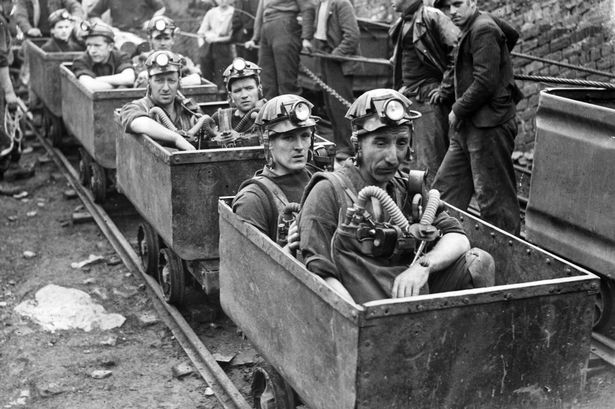
Rescuers at the Knockshinnoch coal pit in New Cumnock, Ayrshire in 1950 where 116 men were trapped underground (Image: Mirrorpix)
Unless you’ve been hiding under a rock recently, you have will heard about climate change, or more dramatically, the climate crisis. People around the world are starting to comprehend that humanities industrial progress over the last three centuries has come at a tremendous cost to the environment.
Climate change means that the warming of the earth’s atmosphere due to burning fossil fuels for energy, heat and transportation will affect almost everyone on the planet in some way, or already has without us yet realizing. If global carbon dioxide emissions are not brought under control by massive global environmental, technological, political, financial, social and personal action, it seems increasingly likely that the global impacts could be much bigger than many of even the most dire scientific scenarios.
Whether you are a resident of hurricane ravaged Bermuda, an Indian farmer facing declining groundwater, a Colorado farmer with not enough snowpack to irrigate your crops, or a resident in rural California, Brazil or Australia faced with yearly catastrophic fires, at some point, the impact of unpredictable and often violent climate events will impact you, in some way, in the foreseeable future.
Understanding the Impact
Understanding the personal impact of a flood or wildfire is visceral, real, and can have financial or life changing impact. Yet understanding the abstractions of climate science, industrial economics, evolving technology or shifting political and financial realities is profoundly more difficult for many people.
There is no shortage of environmental information available. From the sensational fire, floods or droughts on daily news, to internet articles shared on social media, we live in a deluge of information about both environmental problems and solutions.
Yet how do we decide what is important in this deluge of information? What are the overall threads or solutions that tie all this together and allow us to chart a social and economic transition to a sustainable future?
This article is the first in a series of articles about ‘big picture’ transitions necessary to combat climate change and create a sustainable future for humanity and the planet.
These articles are based on a wide-ranging, multidisciplinary and cross-functional research process to provide insights into how to which technologies and solutions will be required to re-orient humanity towards a sustainable future, rather than an exploitative one.
At the core of creating a sustainable future for humanity are four massive transitions. These are systemic shifts that allow us to create a sustainable human ecology, rather than the current unsustainable based on the exploitation of natural resources without fully accounting for the consequences of the resulting carbon emissions into the earth's atmosphere. At some point, if humanity does not limit these emissions, the entire global ecosystem could destabilize and wobble out of control. As nature attempts to self-correct and bring itself back into balance, catastrophic climate change events of different types will occur around the world. Climate scientists have been articulating that it's not just long term raising of temperatures that will be the problem. It's the speed of change or weather patterns that will really cause the damage. That increased speed of change of the weather will result in stronger storms, worse droughts, more intense wildfire seasons, more rainfall in certain places and times, and both higher and lower temperatures. In other words, more extreme weather events everywhere.
These sustainability transitions are primarily technological, but implementing them is more about our mindset and our willingness to change the way we think about energy, about business, and about our global systems. Three of the global sustainability transitions involve decarbonizing the production of energy. Some of the mechanics, data, and science of these energy transitions are still in development. Completing these energy transitions will be not a fast process, but we must act, and act on an unprecedented scale if humanity is to combat climate change. While planting a trillion trees and saving millions of acres of nature may sequester an enormous amount of carbon over time, addressing the issues with humanity's use of fossil fuels must be addressed, and that is the focus of the first three transitions.
The last sustainability transition concerns farming, the food supply, and our daily eating and consumption habits. All four global sustainability transitions are highly contentious, but the fourth one may result in the most impact on our daily lives and habits. Some of the transitions might elicit an ‘over my dead body’ response. They will impact everybody, from wealthy businesspeople to poor farmers.
There is no One-Size-Fits-All Solution
These global sustainability transitions are not prescriptive one-size-fits-all solutions. Rather they are broad concepts that allow each of us to grasp the massive potential that new technologies will serve and allow us to design and innovate our way to sustainable living on planet earth. At different stages of development and wealth, nations will need different mixtures of all solutions. Yet the reality we must face is that millions of us will likely die, be permanently displaced, or have our likelihoods or property destroyed if we don't embrace any or more likely, all of these transitions.
Sustainable thinking requires that cooperation and systemic thinking become the new normal. We’ll need to bring the best minds of the environment, biology, physics, politics, social responsibility, and public policy together in ways that may never have been done before. We'll need to build new international institutions that function very different from any we have yet created. For this to occur, as many people as possible need to understand the big picture solutions, which is why these sustainability transitions are broad in scope and written to be easy to conceptualize and understand.
Sustainability Transition One: Coal to Thorium
The first sustainability transition starts with a question. What is the biggest source of carbon dioxide emissions globally? The answer is this question is coal. Coal is the number one global energy source for industrial production and consumer electricity generation, so transitioning away from coal must also be the number one transition to sustainability that humanity executes.
Coal is cheap, simple to mine, and is found in almost every country on earth. Its ease of extraction and suitability for supplying the steady stream of electricity that is critical for industrialization made it the first choice as nations increase their demand for energy while the raise living standards increase and achieve social progress. In the history of industrial development in almost every society, coal has had its place in that history. As well as being burnt for energy and heat, coal is used in massive quantities to create cement and steel, the primary building materials of industrial economies.
Burning coal is so ingrained in the movement of societies upwards on a path to industrialization and higher living standards, that to declare that the need to stop using it in order to master the climate crisis is almost incomprehensible to many. Let alone replacing it with thorium, an element common in the earth’s crust but which most people have never even heard of.
The everyday nature of coal mining and coal burning, as well as the acceptance of its appalling safety record and public health impacts, is partly why it is surprisingly difficult to dislodge from the energy needs of humanity. China and India, which are in the later stages of a rapid process of industrialization, are still building coal-burning power plants at a rapid rate. They need to do so as no other energy source can currently provide the electricity generation capability their economies need to support the rapidly rising living standards of their enormous populations. Simply put, there is currently no other solution, despite the risks, pollution, and public health impact of burning more coal.
The problem with coal is that is dangerous, and immensely polluting to mine, store and burn. Coal mining has been the source of hundreds of thousands of deaths in mining accidents over its history, and millions of deaths in air pollution that causes lung disease.
The Growth in Renewables is Not Keeping Up
Despite renewable energy sources such as wind and solar showing big increases and receiving much positive press, these increases in renewable energy simply cannot keep up with the global increase in energy demand. While coal is on the decline in the USA and Europe, in the last twenty years the world as a whole has doubled its coal-fired power capacity to around 2045 gigawatts (GW) after explosive growth in China and India, who intend to continue this growth with 700 new coal-fired power plants. This is because the combined 2.7 billion citizens of China and India are still moving towards being becoming fully industrialized societies, and as all societies make that transition, their higher living standards require more and more energy.
Unfortunately, this means that every great intention to reduce CO2 emissions in Europe and the USA by rolling out renewables will be thwarted by new coal-fired power stations being built in China and India. From this perspective of the global population energy footprint, there is only one conceivable solution that provides the energy required for the 2.7 billion people of India and China to live as fully developed industrialized nations, while at the same time reducing the number one form of CO2 emissions globally.
That solution is nuclear energy. But for nuclear energy to gain the necessary public acceptance to replace coal, it must be a form of nuclear energy that bypasses the often irrational fear and environmental objections to the problem of what to do with radioactive nuclear waste.
Nuclear's Public Perception Problem
Public perception of nuclear energy is invariably based on the existing uranium fueled nuclear reactor technologies and their byproduct of highly radioactive nuclear waste, and the risk of reactor meltdown due to the inherent technical design of high-pressure uranium reactors. Despite the enormous historical death toll from coal, there is also the mistaken public perception that nuclear energy is dangerous. In fact, nuclear power is the safest form of energy production by an enormous statistical margin.
Despite the safety record or uranium-based nuclear reactors providing vast quantities of clean, near-zero carbon emission electricity for nearly seventy years in Sweden, France, Germany, Canada, Japan, and the USA, nuclear energy has developed a massive global public relations problem because of the two perceived safety issues of a reactor meltdown and nuclear waste disposal.
Nuclear fission is the process where uranium atoms are split in a nuclear reactor, creating enormous quantities of heat, which is then used to generate steam to drive turbines. The spent fuel remains radioactive for hundreds or even thousands of years, leading to an expensive and unpopular waste management problem. These reactors use extremely high-pressure steam, leading to enormously expensive construction of heavy concrete and steel containment vessels. If the delicate balance of the nuclear reaction is interrupted because of some type of system failure, the reactor core overheats, heating up gases within the containment dome to the point where they explode, releasing enormous quantities of high-pressure radioactive steam. This overheating of the reactor core is what occurred in Chernobyl and Fukushima, although for quite different reasons.
The problem for the nuclear industry has been that essentially, there is no 100% safe way to deal with either the waste from uranium reactors or the remote but catastrophic possibility of these reactor core meltdowns. The best solution to the waste problem involves digging very deep tunnels into the hardest and most impermeable rock around, welding the waste permanently into heavy corrosion-proof containers, then emtombing those containers in solid concrete at the bottom of those tunnels. The problem is where to build the tunnels, how to pay for them, and how to get societies to agree that it is necessary to do so.
The Legacy of the Military-Industrial Complex
Reactor meltdowns needed to be solved another way - by fundamentally changing both nuclear reactor design and the fuel used in them. Thorium is an alternative nuclear fuel to uranium, and also provides a completely different way to make nuclear reactors much, much safer. Thorium reactors are based on designs that were proven back in the earliest days of large-scale nuclear power in the early 1950s and at the time were a viable alternative to uranium reactors. Alvin Weinberg, who was the director at the Oak Ridge research facility in the USA and primarily responsible for thorium test reactor, lost his job as director because he championed the development of these safer thorium reactors rather than less safe uranium ones.
At that time, large-scale defense contracting and public works, commonly known as the military-industrial complex, seemed to have influenced the costlier and less safe decision to use uranium rather than thorium technology. By design, uranium reactors are massively complex and expensive, require enormous amounts of concrete, precision piping, pressure vessels, containment domes and multiple fail-safe control systems in order to prevent the possibility of reactor meltdowns.
An Old Concept whose Time has Come
The thorium concept is quite different from conventional uranium reactors. Instead of uranium packed into delicate control rods that are maneuvered delicately into place in the reactor vessel, a thorium reactor uses liquid fuel of sodium hexaflouride with thorium and small amounts of uranium, a fuel that is a low pressure, high-temperature liquid. Control rods inserted into the liquid can be moved to slow or speed up the nuclear reaction. High-pressure water is piped past the hot liquid, turning it into steam that in turn runs a turbine to generate electricity like in a conventional reactor. However, the high pressure steam never comes into contact with the radioactive fuel source, meaning that even if it were to escape, it would not create a dangerous reactive cloud, such as the one that occurred in Chernobyl.
Because the nuclear fuel in a thorium reactor is a liquid rather than a solid, in the event of a total power failure due to some catastrophic natural disaster such as the tsunami that crippled the Fukushima reactor, the reactor fuel is drained away from the reactor vessel using gravity. This is achieved by refrigerating the liquid in the drainpipe below the reactor to create a frozen plug. If the electricity supply to the frozen plug fails, the plug melts, and the nuclear fuel drains away into an underground containment vessel beneath the reactor. Once in the containment vessel, the molten fuel freezes and becomes relatively inert by radioactive fuel standards.
A soda can size of thorium contains enough energy for the entire lifetime energy supply of a human being.
Compare that to the 15 gallons of gas that the average modern car takes for a week or two worth of commuting, or the thousands of tons of coal daily used by coal-burning powerplants for even small cities. Thorium is plentiful everywhere in the earth's crust. It's often stockpiled as a byproduct of other metals mining processes because there are few commercial uses for it. Best of all, the byproduct is far less radioactive than the waste created by uranium reactors. There is more on thorium reactor technology in my article Taking a New Look at Nuclear Power, published on LinkedIn.
When societies are rapidly expanding their industrial capacity, they need vast amounts of constant power for factories that run around the clock. The societies that are not yet fully developed will be the ones that could benefit from thorium power as they are the ones most rapidly increasing their industrial capacity.
Advanced nations such as Germany, France, and the USA have already moved quite a long way towards becoming a renewables-based society. So much renewable energy is now available from renewables, that in some countries or locations, generation is turned off as there is no demand at the time that the energy is produced. Those countries are already at the point where the generation of renewable energy has increased beyond the capacity of the grid to store it. The issue of what to do with excess electricity from renewables will be addressed in the second article and transition to sustainability, Oil to Hydrogen. The issue of the electricity grid and how to add storage to it will be addressed in the third transition to sustainability, Electrify Everything.
While renewables can be quite suitable for societies that have already completed their pathway to industrialization and have become service-based, industrialization requires 'always on' power to run factories, chemical plants, and steelworks. Thorium is effectively the only known technology today that has the potential to completely displace coal with a new, clean source of ‘always on’ power that is suited to this stage of societal development, and avoid the quagmire of public fears and enormous upfront costs associated with traditional nuclear power generation.
Developing countries need vast and rapidly increasing quantities of power to complete their pathway to industrialization. To do this with thorium-based nuclear power will require a lot of help from the already developed nations to develop this technology at an accelerated pace. In 2017, scientists at the Nuclear Research and Consultancy Group (NRG) in Petten, Netherlands, completed the the world’s first thorium molten salt reactor experiment in over 45 years.
The country that looks closest to starting a serious, scalable thorium power program is currently Indonesia, based on the Thorcon concept, where the entire reactor is built using existing technology in commercial shipyard as an 'island' and then towed to as a large barge to a prepared coastal location.

Proposed Thorcon reactor 'island' that would be built in existing commercial shipyard.
Source: Thorcon Power
An Unprecedented Global Technology Challenge
The coal to thorium sustainability transition provides an unprecedented global political challenge. The level of international technology trust, transfer, and cooperation needed for this task may be unprecedented, perhaps even since the rebuilding of Europe and Japan after the second world war. If already rich countries want still-industrializing countries to reduce their CO2 emissions, they must sponsor and fund the development of thorium nuclear reactor technology, even if that technology may no longer be necessary for their own energy needs.
By replacing coal, the adoption of widespread thorium reactor technology is the technological moonshot that could change the entire energy and carbon equation of humanity for hundreds of years into the future.
The coal to thorium moonshot is such a radical idea that most people haven’t even heard of it. The actual environmental impact of a network of small, clean, failsafe thorium reactors would be vastly smaller than the environmental destruction from coal mining, the millions of tons of CO2 produced by burning that coal, or covering thousands of square miles in solar farms and blanketing landscapes in thousands of massive wind turbines.
Part of the demands of learning about sustainability is that we need a new level of systemic, integrated thinking. We must learn to question our assumptions, look at historical trends, and work hard to define new possibilities that may be well outside our current comfort zones and worldviews. Global carbon-neutral energy sustainability that we embrace these technological moonshots, not just plant trees and conserve existing nature and wildlife, which has traditionally been the focus of the environmental movement.
No one is saying this will be easy, but as the impact of rising global temperatures become more and more evident every year, there is no time to waste.
The Next Transition to Sustainability
In the next article in this series of global sustainability transitions, Oil to Hydrogen, I take a look at the next biggest global energy source after coal, which is oil, and make the case for transitioning away from oil by redeveloping the global oil economy into a new economy based on green hydrogen.
Peter Hill is a founding investor of the environment startup OurWorldToo.